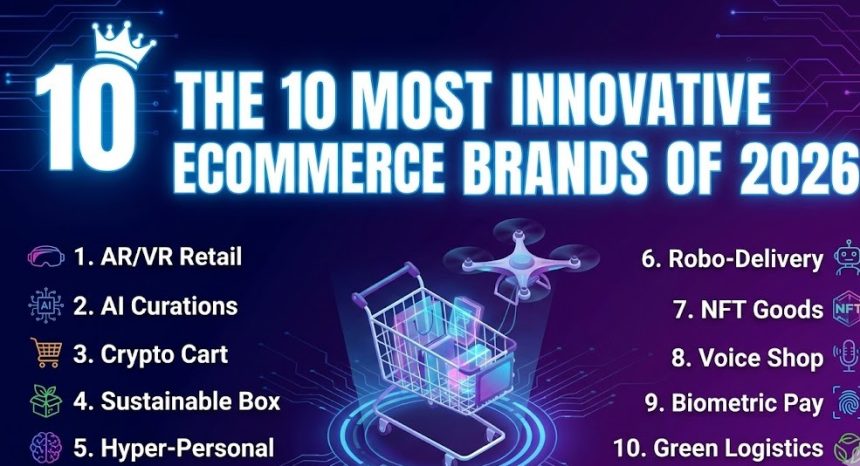
We live in an age where ecommerce is not just growing; it is evolving at lightning speed. To stay afloat in the saturated market of 2026 and reach ambitious business goals, companies must produce truly innovative solutions.
From Augmented Reality (AR) shopping experiences to revolutionary logistics networks, here is the list of the most innovative and original ecommerce brands defining this year.

1. Wayfair
Wayfair is already a household name, but its growth strategy remains a masterclass in scaling. With a massive product range containing millions of items, the sheer volume of choice could easily overwhelm customers.
The Innovation: Wayfair solved the “choice paralysis” problem by separating its massive inventory into several distinct lifestyle brands (like AllModern, Joss & Main, and Birch Lane), each with its own dedicated website. Furthermore, Wayfair has developed a lightning-fast logistics system. By shipping items directly from suppliers to consumers, they reduce overhead costs while increasing delivery speed—a crucial factor in 2026’s competitive market.
2. Dutil
This denim company is breaking down social constructs to expand its market share. Dutil is notable for trying to ruin gender barriers by providing goods that cater to all categories of customers.
The Innovation: By producing a wide range of unisex wear, Dutil increases its potential customer base instantly. Their website is praised for its convenient functionality, helping users choose the perfect denim fit without being constrained by traditional gender categories.
3. Think Crucial
Think Crucial is a prime example of the power of multi-channel selling.
The Innovation: Instead of relying on a single storefront, Think Crucial sells its products across numerous marketplaces, including eBay, Sears, and Overstock. They have developed a specialized approach for each platform, maximizing visibility. Their success story proves that diversifying sales channels is a key strategy for increasing profit and mitigating risk.
4. Hollar
Hollar takes an unusual approach to the discount retail model, catering specifically to young families and millennials who value aesthetics as much as savings.
The Innovation: To keep prices rock-bottom, Hollar implements a minimum order value, persuading clients to buy in bundles. While they may not have the fastest logistics system (delivery can take several days), their target audience accepts the trade-off for the incredible prices. Their visually pleasing website contrasts sharply with the cluttered look of traditional discount stores.
5. Knoxlabs
A “splash page” is usually a simple web page customers see for a few seconds before entering a main site. Most companies ignore them; Knoxlabs monetized them.
The Innovation: Knoxlabs grabbed the attention of the VR (Virtual Reality) market by creating aesthetic and exciting splash pages that build hype before the customer even browses the catalog. This unique sales funnel caused rapid brand growth, allowing them to move a high volume of VR cardboard units in a short period.
6. Everytable
For decades, the assumption was that food could be cheap and unhealthy, or expensive and healthy. Everytable set out to break this binary.
The Innovation: Everytable developed a business model that drastically reduces the cost of cooking restaurant-quality food. By utilizing a central kitchen and small, efficient storefronts, they sell fresh, healthy meals at prices comparable to fast food. In 2026, they are a beacon for food justice, proving customers don’t have to compromise health for their budget.
7. Harry’s
Marketers know that word-of-mouth is the most powerful advertising tool. However, getting customers to actually share a brand is difficult.
The Innovation: Harry’s revolutionized the referral program by gamifying it. Rather than a simple “give $5, get $5” offer, they created a tiered system where inviting more friends unlocks better physical prizes. Customers treated the referral program like a game, resulting in a viral loop that invited significantly more users than traditional marketing methods.
8. Magnolia Market
While many brands are just starting to experiment with Augmented Reality (AR), Magnolia Market has fully integrated it into the shopping experience.
The Innovation: The official app allows customers to visualize products in their own homes before buying. Similar to the mechanics of the popular Pokémon GO game, the AR tool lets users see exactly how a vase or piece of furniture will look in their room, drastically reducing return rates and increasing buyer confidence.
9. Netflix
While primarily a content creator, Netflix is reshaping the commerce landscape through the “merch-ification” of media.
The Innovation: Netflix’s influence on ecommerce is indirect but massive. The success of their original series drives merchandise sales and sets fashion trends globally. As they continue to grow, the line between “viewer” and “shopper” blurs, with Netflix implementing innovative solutions to keep users within their ecosystem for entertainment and consumption alike.
10. Uber
Uber has evolved far beyond a simple taxi service. It is now a logistics behemoth.
The Innovation: Uber continues to change the concept of transportation by integrating goods delivery and mobility into a single “Super App.” With each update, they bring more functionality—from food delivery to freight—ensuring they remain indispensable to the daily lives of their users.
Conclusion
Giants like Amazon and Google will always be leaders in the space. However, true innovation often comes from smaller players willing to take risks.
There are no constants in the ecommerce market. As demonstrated by brands like Wayfair and Everytable, success in 2026 comes to those who solve old problems in new ways. To stay ahead, businesses must always keep a pulse on these evolving trends.
Also Read : 10 Best Dropshipping sites for E-commerce