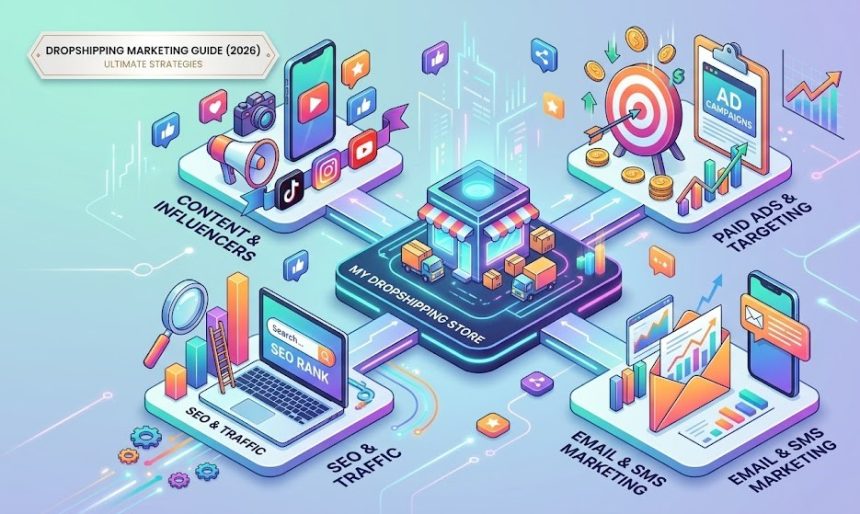
In 2026, dropshipping has evolved beyond simple product listing. With the global dropshipping market projected to hit $1.3 trillion this year, the “easy business” promise is real, but competition is fiercer than ever. Marketing your store is no longer just about getting clicks; it’s about using AI-driven automation, social commerce, and high-velocity content to build a brand that people trust.

Step 1: Understand Your “Agentic” Audience
One of the biggest shifts in 2026 is Agentic Commerce—where AI agents often help consumers find products. To win, you must define your audience with surgical precision.
- Define Your Persona: Use demographics (age, income), but focus on behavior (e.g., “Tier-2 shoppers who prefer Cash-on-Delivery”) and pain points.
- Data-Driven Insights: Don’t guess. Use Meta Audience Insights or AI tools like Minea to spy on what’s actually converting in your niche.
- The “Hook” Strategy: A gym-goer needs a different ad hook than a remote worker for the same posture corrector. Personalize your marketing to the sub-niche.
Step 2: Social Commerce & Short-Form Video
Social commerce is expected to drive 40% of all dropshipping sales in 2026. If your product isn’t on video, it doesn’t exist.
- TikTok Shop & Spark Ads: TikTok is the #1 channel for product discovery. Use Spark Ads to run ads through a creator’s real account rather than your brand’s. This builds 67% more trust than traditional ads.
- YouTube Shorts & Live Selling: YouTube is the king of SEO-integrated video. Leverage YouTube Shopping to tag products directly in tutorials that drive traffic for years.
- Instagram Reels: Short video ads on Reels convert 6.5X better than static images. Focus on “raw” and “authentic” content over polished professional shots.
Step 3: AI-Powered Search Visibility (SEO 2.0)
SEO in 2026 isn’t just about keywords; it’s about being visible to AI search engines (like Perplexity or Google’s AI Overviews).
- AI Content Generation: 94% of marketers now use AI for content. Use tools like Frase.io or Surfer SEO to generate data-driven content blueprints.
- Automate the Tedious: Use Alli AI to automatically optimize thousands of product pages for technical SEO and site speed.
- Problem-Solving Blogs: Write “5W1H” (Who, What, When, Where, Why, How) guides. A blog post on “How to Cure Back Pain” is your #1 long-term ROI-generating channel.
Step 4: Paid Ads & Aggressive Scaling
Paid ads provide the velocity needed to test products. However, 2026 demands “predictive” spending.
- Meta (Facebook/Instagram): Still the highest ROI platform for 43% of marketers. Start with $10–$30/day to test creatives.
- Google Shopping Ads: Best for capturing high-intent buyers. Around 85% of e-commerce clicks come from these ads.
- AI Creative Testing: Use AI tools to generate 20+ variations of an ad script in minutes. Rapidly kill “low-CTR” ads and scale the winners.
Step 5: Retention via Email & SMS Automation
Acquiring a new customer is 5X more expensive than keeping one.
- Abandoned Cart Flows: Send your first reminder at 1 hour, a reassurance message at 24 hours, and a discount offer at 48 hours.
- Community-Based Marketing: Create WhatsApp Communities or Telegram Channels where loyal customers get early access to “drops” and exclusive deals.
- Loyalty Programs: In 2026, subscription-based dropshipping is growing 80% faster than one-time sales. Use Klaviyo to segment your “VIP” buyers.
Must-Have Marketing Tools for 2026
- Minea: The #1 tool for spying on live ad creatives across TikTok, Facebook, and Pinterest.
- DSers: Standard for automated order processing and supplier communication.
- Hotjar: Use heatmaps to see where users drop off in your checkout funnel.
- ManyChat: Automate your Instagram and Facebook DM marketing to close sales 24/7.
- SEMrush: Essential for competitor keyword analysis and organic growth.
Also Read : 10 Best Dropshipping sites for E-commerce