Let’s be completely candid: dropshipping is often sold as a “get rich quick” scheme, but the reality is that it is a highly competitive, data-driven business model.
The beauty of dropshipping is that you do not need to buy or hold any physical inventory. When a customer orders a product from your store, your supplier ships it directly to them, leaving you with the profit margin. However, to succeed, you need meticulous product research, a reliable supplier, and a killer marketing strategy.
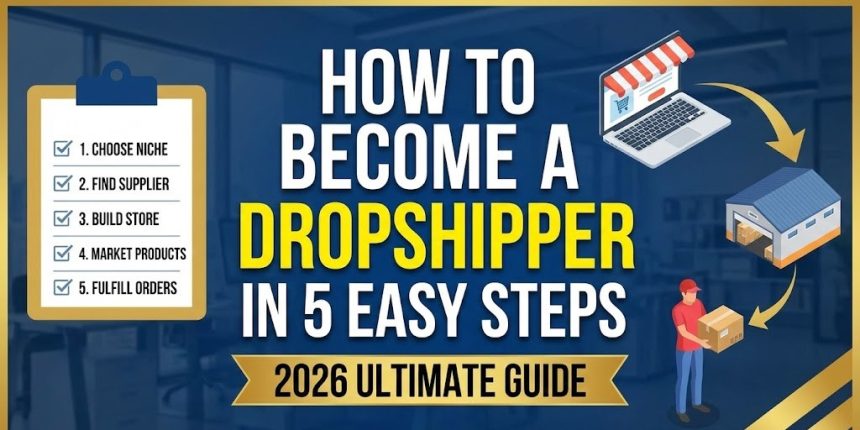
Here is a straightforward, no-nonsense breakdown of the 5 steps you need to take to build a profitable dropshipping store from scratch.

At a Glance: The 5-Step Dropshipping Blueprint
| The Step | The Objective | Key Tools & Platforms |
| 1. Find a Winning Product | Identify an item with high demand, low competition, and a 20–25% profit margin. | Dropship, TikTok, Amazon Best-Sellers |
| 2. Find a Supplier | Source the product from a manufacturer who will fulfill orders blindly (no logos). | AliExpress, AutoDS, Printify |
| 3. Build Your Storefront | Create a trustworthy, high-converting e-commerce website. | Shopify, WooCommerce, Amazon |
| 4. Market Your Products | Drive highly targeted traffic to your product pages using paid ads and social media. | Meta Ads, TikTok Ads, SEO |
| 5. Analyze & Optimize | Track your data, cut losing ad campaigns, and scale what works. | Google Analytics, Store Dashboards |
Step 1: Find a Winning Product
To be a successful dropshipper, you need a product that solves a problem or taps into a passionate niche. A “winning product” typically features high demand, low competition, and a healthy 20% to 25% profit margin.
- Where to Look: Think about problems in your own life, check the “Movers and Shakers” lists on marketplaces, or monitor trending hashtags on social media.
- Use Data Tools: Don’t just guess. Use dedicated product research tools (like the Dropship app) to uncover hidden data on competitor sales, store traffic, and revenue to validate your product idea before spending a dime.
Step 2: Source a Reliable Supplier
You have found a winning product; now you need someone to make it and ship it. Reach out to multiple suppliers and ask strict questions about their shipping costs, processing times, and return policies.
- AliExpress: The go-to B2C marketplace made up of Chinese manufacturers. It is highly popular due to its cheap products and massive selection.
- AutoDS: An automation tool that connects your store with various suppliers and automatically fulfills orders the moment a customer pays.
- Printify & Printful: If you want to sell customized goods (like apparel or mugs), these print-on-demand suppliers will print your designs and ship them directly to your buyers.
Step 3: Choose Where You’re Going to Sell
You need a digital storefront to host your products. While you can sell on marketplaces like Amazon (which gives you instant traffic but comes with high fees and fierce competition), building your own website gives you complete control over your brand and profit margins.
- Shopify: In our experience, this is the absolute best platform for dropshipping. It is incredibly easy to use and integrates seamlessly with almost every dropshipping automation tool on the market.
- WooCommerce: The best free, open-source alternative if you already know how to build and manage a WordPress website.
- BigCommerce: A robust, purpose-built e-commerce platform that offers deep customization for more advanced sellers.
Step 4: Market Your Products
Your website is live, but nobody knows it exists yet. You need to drive targeted traffic to your store. Before launching campaigns, clearly define your target audience’s age, location, and interests.
- Paid Advertising: Using platforms like the Meta Ads Manager (Facebook/Instagram) or TikTok Ads is the fastest way to get your product in front of buyers.
- Organic Social Media: Create engaging, short-form video content demonstrating how your product works to build brand awareness without spending money on ads.
Step 5: Analyze and Optimize
Once the sales start rolling in (or if they aren’t), you must let the data guide your next moves.
Use tools like Google Analytics and your Shopify dashboard to track your conversion rates and cost-per-acquisition. If a specific Facebook ad is draining your budget without generating sales, kill it immediately. If a specific audience demographic is buying in droves, double your ad spend there. Dropshipping is a game of constant testing, analyzing, and optimizing.