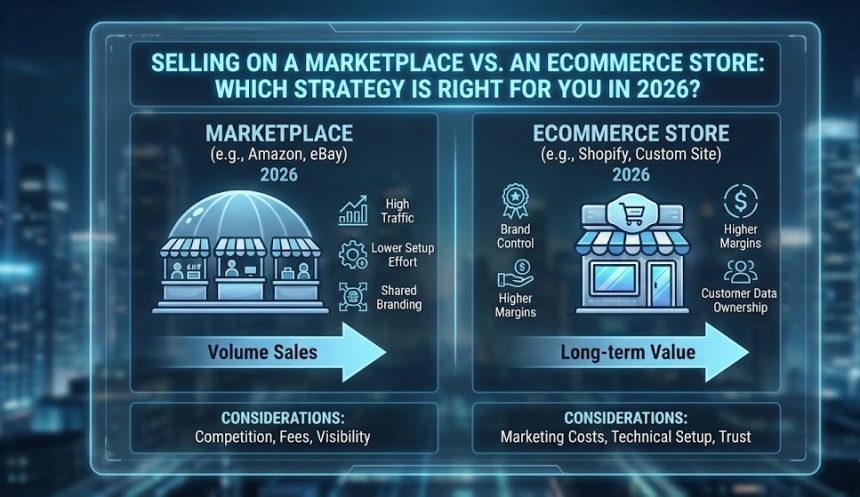
When launching your eCommerce business, one of the first and most critical decisions you will face is choosing exactly where to sell your products.
Should you leverage the massive, built-in traffic of a marketplace like Amazon, or should you build your own independent online store from scratch? Each option carries distinct advantages, steep challenges, and vastly different profit margins.
In this comprehensive guide, we will break down the true costs, the pros and cons of both options, and the powerful “hybrid approach” to help you determine which strategy is best for scaling your business this year.

The Core Difference: Marketplaces vs. Owned eCommerce Sites
At a high level, marketplaces (like Amazon, eBay, or Etsy) are platforms where multiple independent sellers list their products side-by-side.
- The Draw: These platforms attract millions of highly motivated shoppers. They provide built-in infrastructure for payment processing, customer service, and even shipping (via programs like Amazon FBA).
- The Catch: Sellers pay listing fees and high commission percentages on each sale, and you never truly “own” your customer data.
On the other hand, an eCommerce site is your own standalone online store, typically built using SaaS platforms like Shopify, WooCommerce, or Magento.
- The Draw: You maintain 100% control over your branding, customer experience, pricing, and analytics.
- The Catch: You are solely responsible for driving every single visitor to your site through paid marketing or SEO, handling your own shipping logistics, and managing customer service.
Why You Should Start by Selling on Marketplaces
If you are a beginner, starting on a marketplace like Amazon is often the wisest and safest choice. The primary reason? Traffic.
Getting visitors to a brand-new, unknown website is incredibly challenging and expensive. Amazon holds a massive advantage in this area, drawing millions of high-intent shoppers daily. Consider this: 9 out of 10 consumers check Amazon to compare prices before making a purchase, even if they initially discovered the product on social media.
According to industry data from Statista, Amazon accounted for over 40% of total retail eCommerce sales in the U.S. recently. More importantly, over 60% of all Amazon sales come from independent sellers—small to medium-sized businesses just like yours.
The Real Cost Breakdown: Amazon vs. Shopify
Let’s look at the actual math of selling a $50 car brake rotor to see why marketplaces are often cheaper at launch.
Selling on Amazon:
- Subscription: $39.99/month (Professional Plan)
- Referral Fee (Automotive Category): 12%
- Cost per $50 Sale: $6.00
- Marketing Cost: Minimal. Because Amazon brings the traffic, your customer acquisition cost (CAC) is incredibly low. If you run basic Amazon PPC ads, the average Cost-Per-Click is just $0.99.
Selling on your own Shopify Store:
- Subscription: $25 to $399/month based on your plan
- Transaction Fee (Basic Plan): 2.9% + $0.30
- Cost per $50 Sale: $1.75 * The Hidden Marketing Cost: This is where owned stores get expensive. You have to buy your traffic. If you spend $500 on Google Ads at $0.40 a click with a standard 2% conversion rate, your **marketing cost per sale jumps to $20**. Add in the costs of professional SEO tools like Ahrefs or an agency ($3,000+/month), and the initial overhead is massive.
Pros and Cons of Marketplaces
- ✅ Pros: Instant access to millions of buyers; low overhead for testing new product viability; built-in consumer trust; easy setup.
- ❌ Cons: High commission fees; intense side-by-side competition; zero control over branding; constant risk of account suspension without notice.
Choosing the Right Marketplace for Your Niche
If you decide to take the marketplace route, you must align your platform with your target audience:
- Amazon: The undisputed king for mass-market goods (electronics, home goods, auto parts). Ideal for sellers who can handle strict fulfillment rules and competitive pricing.
- eBay: Perfect for unique, second-hand, vintage, or refurbished niche items.
- Walmart Marketplace: A rapidly growing Amazon competitor. Ideal for everyday household goods, though you must meet Walmart’s strict seller requirements to be approved.
- Etsy: The global hub for artisan, handmade, and vintage goods. Highly recommended for small-scale creators and artists.
When Should You Create Your Own eCommerce Site?
While marketplaces offer incredible reach, some businesses eventually outgrow them.
You should absolutely build your own store if you sell restricted items (like firearms or certain supplements), run a recurring subscription model, or prioritize premium brand storytelling.
For example, if you sell handcrafted, bespoke jewelry, an Etsy listing puts you next to thousands of cheaper, mass-produced competitors. Having your own highly aesthetic eCommerce store provides a blank canvas to tell your brand story, highlight your craftsmanship, and create a premium, personalized shopping experience that justifies a higher price tag.
Pros and Cons of an Owned eCommerce Site
- ✅ Pros: Complete operational control; 100% ownership of customer data for email marketing; no risk of sudden account suspension; beautiful, unrestricted branding.
- ❌ Cons: High setup and maintenance costs; entirely responsible for your own website security; massive customer acquisition and advertising costs.
💡 The Winning Strategy: The Hybrid Approach
You do not have to choose just one. The most successful multi-million dollar brands in 2026 utilize a multichannel retail strategy, also known as the hybrid approach.
Start by launching your top-performing products on a marketplace like Amazon to gain immediate cash flow, brand recognition, and momentum. Once you have a steady revenue stream, use those profits to slowly build your own Shopify or WooCommerce store. You can eventually offer exclusive bundles, subscriptions, or full product catalogs only on your website, migrating your marketplace buyers over to your owned platform where you keep 100% of the profits.
How to Manage It All: Running a hybrid model manually is impossible. You need software like Spark Shipping to automate the chaos. Spark integrates your marketplace accounts directly with your standalone website, automatically syncing your inventory levels, routing orders to your suppliers, and updating tracking numbers in real-time across every platform you sell on.
The Bottom Line
There is no one-size-fits-all answer. If you have a small budget and need immediate sales, launch on a marketplace. If you have significant marketing capital and want to build a legacy brand, launch your own store. And if you want to dominate the industry, use a hybrid approach to leverage the best of both worlds!
Also Read : The Top 50 Best Dropshipping Products to Sell in 2026